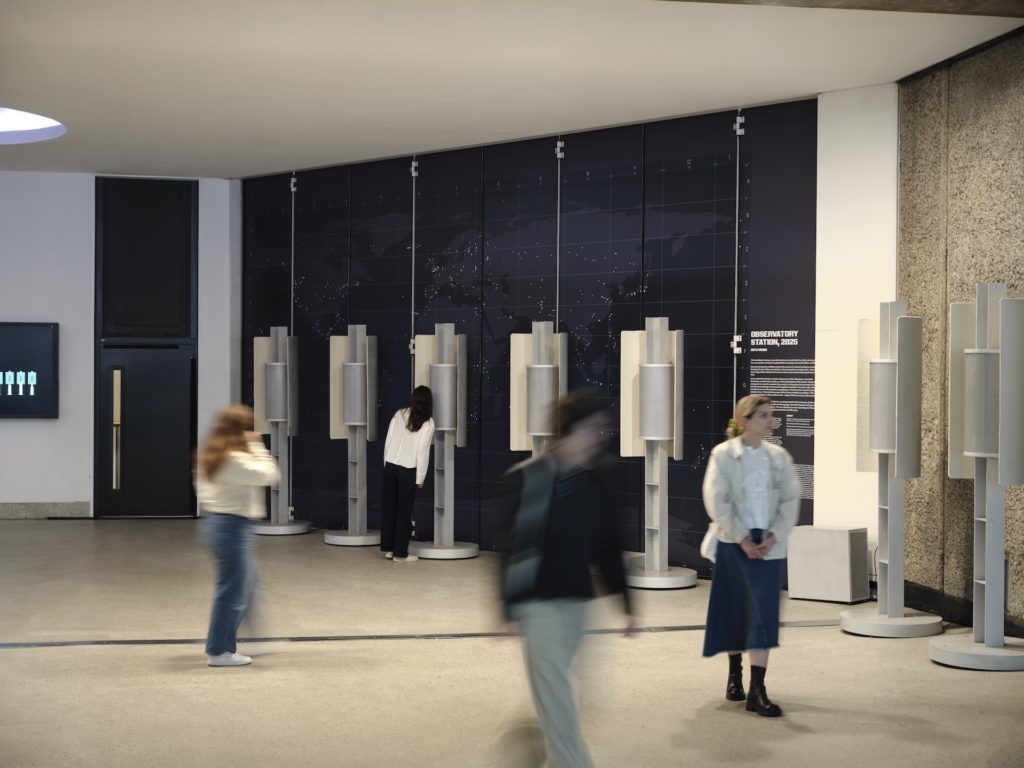
Observatory Station
Barbican Centre
- Installation
- 2025
A device to imagine our world through sounds left behind by others from the past
This work was commissioned by the Barbican Centre, a cultural institution of the City of London.
It was inspired by an audio recording entrusted to the artist by a friend from abroad in 2023. A hometown reduced to rubble after becoming a war zone. Voices of protest. Wildfires. An area rendered uninhabitable by a nuclear accident. A quiet night during the pandemic. A bus stop tied to memory.
A peaceful backyard morning. A lively market. A beach. A construction site. A ski resort. Traditional festivals and prayers. Children playing around a fountain. Insects and animals. What were the recordists hoping to convey to us?
In our information-saturated society, we are often given too much. In contrast, the details of the recordings in this piece are intentionally withheld. Viewers are invited to navigate through the sounds with their own experiences and thoughts, exploring every possibility.
What matters most is not where or when the recordings were made, but the simple fact that someone left them behind—for us. By imagining the world of the other, we begin to communicate through sound, across time and space.
We perceive more information from sound than we realize: human presence, spatial dimensions, proximity, recording equipment, even the era—some of the recordings date back to the 1990s. You may begin to imagine what kind of person was behind the microphone. Even a single “noise” is made up of countless subtle layers, once you listen closely.
System
This work incorporates field recordings contributed by the international sound community Cities and Memory, along with public domain sounds and recordings by the artist.
Each audio file contains “location data” and either the “recorded time” or a “description” of the sound.
These three elements—time, location, and language—are tools we humans have created to make sense of the world. Sound, as a medium, carries vast information but remains inherently ambiguous. Through these perspectives, we may begin to notice patterns, contrasts, and resonances between each sound.
Twelve independent speakers play sound excerpts, preceded by periodic announcements indicating what kind of sound is about to be heard: for instance, the sound of 6:00 AM across various regions, or themes such as wind, prayer, gunfire, frogs, or schoolyards.
What might differences in latitude and longitude reveal to us? What kinds of landscapes come to mind from twelve distinct recordings of rain?
During the exhibition, a white box containing a microphone will periodically appear in different locations. Sounds from the Barbican Centre itself will also be archived—and at times played back in real time.
Lastly, there may be moments when not all speakers are active, or when the same sound repeats. This reflects the fact that some regions remain undocumented, or have yet to be reached by human presence. (Of course, the recordings in this work are only a small fraction of what exists.) These silences are intentional. They will gradually be filled—as mobility and environmental conditions shift. Perhaps in ten years. Perhaps in a thousand.
This piece holds space for what has yet to be heard.
We hope this work will outlive us—and continue to be filled with sound in the future.
With gratitude to all the contributors around the world.
About Cities and Memory
Cities and Memory, who collaborated with us on this project, is one of the world’s largest sound projects, covering 130 countries with over 7,000 sounds and 2,000 contributing artists. Founded by Stuart Fowkes in 2015, it reimagines field recordings to create new ways of listening, exploring sound and memory across topics like migration, climate change, and protest. Listeners can experience real and reimagined soundscapes through an interactive sound map. The project has partnered with organisations like C40 Cities and the University of Oxford, and has been featured in global media including The Guardian, BBC, and The New York Times.
https://citiesandmemory.com/
Contribute your sound
This work is also collecting audio submissions through Cities and Memory during this exhibition. For more details, please access the URL. Credits for the audio submissions received during the exhibition period will also be updated on the website as they are processed.
https://citiesandmemory.com/observatory-station/
Credit
- Contributors
- Alex Roth
- Alex Wegman
- Aliesha King
- Amanda Butterworth
- Anders
- Anders Vinjar
- Andre Louis
- Andrea Lynn
- Andrew Ramsey
- Andy Popperwell
- Angela Tisner
- Antek Rutczynski
- Ayaka Toki
- Ayane Sato
- Ben Gale
- Benj Meamo III
- Bibian Marcela Riveros Bustamante
- Bill McKenna
- Brandon Ligon
- CHRISTINA ANTONIADOU_Soundquest
- Cities and Memory
- Claire Matthews
- Colin Hunter
- Constantine Katsiris
- Daniel Trussler
- Daniel W J Mackenzie
- David Mintom
- Dee Fry Servals
- Diego Herledy Mendivelso Albarracin
- Dorota Blaszczak
- Dylan Spencer-Davidson
- Emiko Morita
- Fabian David Paz Castro
- Farhan Boy
- Felice Sciorilli
- Felicia Barr
- Ferran Destemple
- Francesco Ganassin – Sergio Marchesini
- Gary Pitt
- George Gower
- George Hiraoka Cloke
- gopinath
- Grace High
- Guillaume Piccarreta
- Helen Copnall
- Heu
- Hidenori Suzuki
- Jakob Rosin
- Jamie House
- Janina Castro
- Jason Richardson
- Juan Martín González
- Juan Martín González Molina
- Julie Woolmore
- Junya Suzuki
- Kaori Oda
- Kathleen Judge
- Lara Band
- Lena Achtelik
- Leonardo andres Manrique
- Lisa Germany
- Luca Nasciuti
- Ludovic Finck
- Marcelo Carneiro
- Marg Laing
- Maria Fernanda Navarro
- Mariana Carrascal Díaz
- Martin Franklin/Les Reynolds
- Mary Hooper
- Matt Rogalsky
- Matthew Shenton
- miduno
- minami kamada
- Mira Rizki Kurnia
- Mitsuhito Ando
- Namshil Lee
- Nanami Sudo
- Natsumi Aoyagi
- Neil Spencer Bruce
- Nicola Fumo Frattegiani
- Nishikawa Yoshihiro
- Ojasvani Dahiya
- Paul Stephens-Wood
- Pawel Gozdziewicz (Canis Arboris)
- Peter Brooks
- philippe neau
- Plazo de mercado marco fidel Suárez
- Rachel Larsen-Jones
- Rafael Diogo
- Raku Nakahara
- Rebecca Ainsworth
- Riku
- Robert Gillespie
- Rurihiko Hara
- Ryosuke Kondo
- Samuel Kudjodzi
- Shachaf Polakow
- Shaye Thiel
- Sirpa Jokinen
- Sonja van Kerkhoff
- Stefan Jürke
- Sylvain Souklaye
- Taiji Okuda
- Takayuki Ito
- Takeshi Azuma
- Tenali Hrenak
- THIERRY J.D. BERNARD
- Timmy Romero
- Timothée Lambrecqi
- Tomasz M. Buga
- Toni Dimitrov
- Toshihiko Kasai
- Troy David Ouellette
- UIRO
- Xiaoya Zhao
- Yoichi Watanabe
- Yuka Hachiya
- Yuto Miyazono
- Yuya Ito
- ZAK
- and public domain data from Freesound
- Team
- Field recordings provided by global sound project Cities and Memory.
- Technical Direction/Programming: Takayuki Ito
- Map design by Matthew Sequel Lewis
- Special Thanks: Guillaume Piccarreta, Tadashi Matsui (Nagano Prefectural Art Museum), Junya Yamamine, Akio Hayashi, Takahisa Abe, Yuya Ito (arsaffix Inc.), Mitsuhito Ando, Reiri Kojima, Gallery 38
- Photo #3
- Feel the Sound at the Barbican / Installation view / 22 May – 31 August 2025
- © Thomas Adank / Barbican Centre